If you’ve ever sat suspended above the water on the New Jersey Turnpike’s Newark Bay–Hudson County Extension at rush hour, the sensory reality is unmistakable: the low hum of idling diesel engines, the saltwater breeze rolling off Port Newark, and the rhythmic, jarring rattle of tires crossing roadway joints that have carried seven decades of interstate commerce.
On November 5, 2026, state officials gathered along the waterfront to mark a ceremonial milestone: the aging Vincent R. Casciano Memorial Bridge—a steel-truss landmark opened in 1956—is finally yielding to a modern successor.

Carrying an estimated price tag near $6.7 billion, the capital project will replace the deteriorating crossing with a sleek, high-tensile cable-stayed span engineered to open by 2031.
Yet for communities watching from the Newark, the defining story is not merely that heavy equipment is mobilizing along the water. It is the critical policy pivot that reshaped the blueprint: the conscious rejection of an eight-lane highway expansion in favor of a climate-conscious, community-focused compromise.
The Policy Pivot: Four Lanes Over Eight
To understand the project’s significance, one must revisit the intense grassroots resistance that greeted earlier proposals. Initial state blueprints envisioned an aggressive highway widening project that would have doubled the bridge’s capacity to eight travel lanes.
Urban planners, environmental justice organizations, and frontline residents across Newark and Hudson County immediately pushed back. Expanding highway corridors in the 21st century invariably triggers induced demand—drawing more vehicular volume, worsening traffic bottlenecks, and funneling particulate pollution into urban neighborhoods that already shoulder New Jersey’s highest rates of pediatric asthma and respiratory illness.
In response, the state formally changed direction, advancing a refined four-lane replacement rather than doubling down on vehicular sprawl.
The finalized blueprint preserves the existing travel footprint—two lanes in each direction—while introducing:
• Standard full-width safety shoulders to clear vehicle breakdowns without snarling traffic.
• Modern emergency access lanes to accelerate regional first-responder response times.
• Upgraded approaches engineered to eliminate hazardous merges without increasing general traffic lanes.
By modernizing obsolete infrastructure while refusing to expand lane capacity, the project strikes a practical compromise: it renews an essential freight conduit without encumbering flanking urban neighborhoods with expanded tailpipe emissions.
Engineering Evolution: 1956 vs. 2031
The visual and physical contrast between the 1956 truss bridge and its cable-stayed successor charts seventy years of evolution in American bridge engineering:
| Structural Feature | The 1956 Vincent R. Casciano Bridge | The 2031 Cable-Stayed Replacement |
| Structural Type | Riveted steel through-truss and deck-truss spans | Sleek, high-tension steel cable-stayed towers |
| Marine Footprint | Heavy array of concrete piers driven into the bay bed | Slender vertical pylons minimizing in-water foundation pilings |
| Travel Cross-Section | Four narrow lanes with minimal to no emergency shoulders | Four travel lanes flanked by full modern safety shoulders |
| Materials & Maintenance | Structural steel prone to salt-spray corrosion and fatigue | Advanced corrosion-resistant composites and modular deck panels |
| Planning Doctrine | Mid-century auto dominance and rapid capacity additions | Multimodal freight efficiency and environmental mitigation |
Slender towers and suspended cable stays distribute structural loads efficiently, reducing the number of underwater piers required in Newark Bay. This reduction directly safeguards the delicate marine ecology and tidal flows of the estuary while providing higher clearance for maritime container traffic.
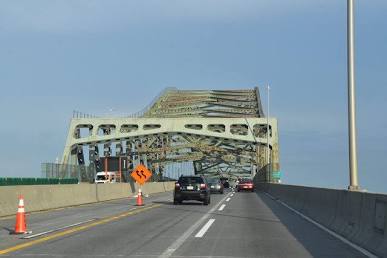
Source: Historic Bridges
The Ground-Level Economic Stakes
The economic necessity of the crossing is clear. The Newark Bay Bridge serves as the vital freight spine linking Port Newark–Elizabeth Marine Terminal, regional rail transfer yards, and industrial warehousing clusters to Bayonne, Jersey City, the Holland Tunnel, and lower Manhattan. A sustained bottleneck or structural failure on this link reverberates through regional supply chains within hours.
State projections estimate that the $6.7 billion undertaking will support approximately 19,000 direct and indirect jobs across its multi-year construction window.
Yet regional employment tallies do not automatically guarantee local paychecks in Newark. For the megaproject to deliver real equity, local leaders, trade unions, and the New Jersey Turnpike Authority must establish and enforce:
- Strict Local Hiring Mandates: Binding apprenticeship and journeyman quotas for residents of Newark’s South and East Wards.
- Minority Business Enterprise (MBE) Contracting: Transparent subcontractor bidding opportunities for woman-, minority-, and veteran-owned firms in Essex and Hudson counties.
- Union Apprenticeship Pipelines: Direct workforce pathways connecting local vocational graduates and non-traditional workers to building trades careers.
A signature skyline upgrade falls short of its potential if the workers living within sight of the rising towers cannot access the jobs on-site.
Looking Ahead to 2031
Demolishing and replacing a primary logistics artery while maintaining continuous commercial traffic will challenge engineers and regional planners through the end of the decade.
If built with accountability to surrounding neighborhoods, the new Newark Bay Bridge will offer far more than a clean geometric silhouette on the waterfront. It will demonstrate that New Jersey can replace decaying mid-century infrastructure, support regional commerce, and protect community health without repeating the urban planning mistakes of 1956.